

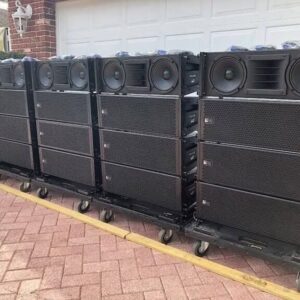
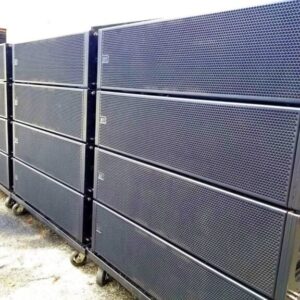
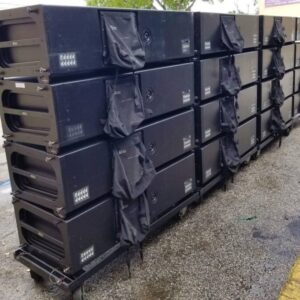
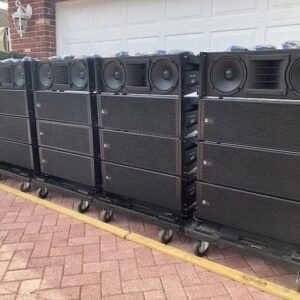
Meyer Sound MILO / M’elodie – Complete Touring Line Array System Block (Europe Buy or Rent)
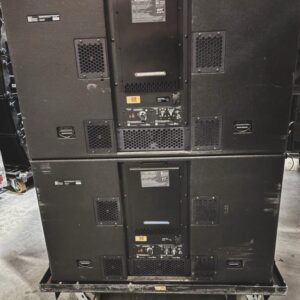
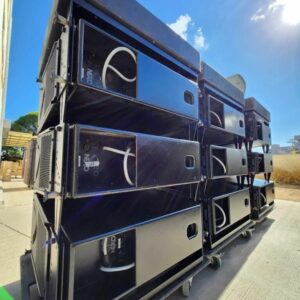
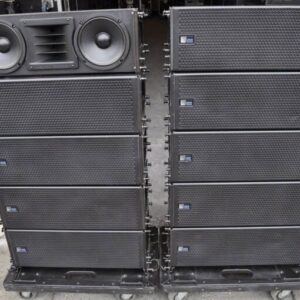
The Meyer Sound MILO / M’elodie system is not just a pair of speakers—it’s a fully engineered line array ecosystem built for real-world touring, festivals, and demanding installations across Europe.
While newer systems exist, MILO and M’elodie remain relevant because they solve a core problem better than most:
delivering consistent, predictable sound coverage across complex venues without constant correction.
Built by Meyer Sound, this system is designed for professionals who prioritize control, reliability, and repeatable performance over hype.
SYSTEM BLOCK OVERVIEW – HOW MILO & M’ELODIE WORK TOGETHER
You should never approach this system as individual components.
It operates as a layered coverage architecture:
Core System Structure
- Main Hang (Long Throw): MILO arrays
- Downfill / Near Field: M’elodie arrays
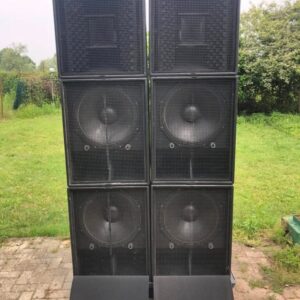
- Low Frequency: Typically paired with 1100-LFC
- Control Layer: Self-powered DSP + system prediction (MAPP)
Why This Matters in Practice
In most systems, engineers fight:
- Overpowered front rows
- Weak mid-field
- Inconsistent tonal balance
With MILO + M’elodie:
- Long throw and near field are separately optimized but tonally matched
- The system behaves as one continuous sound field
- You reduce corrective EQ and system stress
MILO – THE LONG-THROW ENGINE (CORE POWER LAYER)
The MILO is the backbone of the system. It handles distance, pressure, and coverage consistency.
Engineering Design
- 4-way self-powered architecture
- High-output driver configuration
- Designed for vertical curvilinear arraying
What MILO Actually Delivers in the Field
1. High SPL Without Breakdown
- Peak output: ~140 dB
- Maintains clarity under load
In real-world touring:
- You can run at high levels for long durations
- The system does not “collapse” sonically
2. Controlled Vertical Coverage (Curvilinear Design)
Unlike flat arrays, MILO uses a curved array geometry.
Result:
- Smooth vertical dispersion
- Even energy distribution across audience depth
- Reduced destructive interference
3. Long-Throw Precision
In large European venues (arenas, outdoor festivals):
- MILO delivers clear vocals and defined highs even at distance
- No “washy” sound at the back of the audience
4. System Stability Under Pressure
During multi-hour events:
- Thermal stability remains consistent
- Output does not degrade
- Tonal balance stays intact
This is critical for festivals and touring productions.
M’ELODIE – THE PRECISION COVERAGE LAYER
The M’elodie is not a secondary speaker—it is a precision tool for fixing the most common coverage problems.
What M’elodie Solves
1. Front-Row Overload Problem
Without proper downfill:
- Front rows get too much high-mid energy
- Audience fatigue increases
With M’elodie:
- Controlled near-field coverage
- Balanced tonal response at short distance
2. Under-Balcony and Complex Venues
In European venues with:
- Balconies
- Reflective surfaces
- Irregular layouts
M’elodie is deployed to:
- Fill acoustic shadows
- Maintain clarity where main arrays cannot reach
3. Tonal Continuity Across the Entire Audience
Because M’elodie shares Meyer’s voicing philosophy:
- No audible shift between near and far field
- Smooth frequency transition across zones
4. Compact but High Output
- Peak SPL ~131 dB
- Wide horizontal coverage (~100°)
This allows:
- Fewer cabinets
- Cleaner rigging
- Reduced visual impact
LOW-FREQUENCY INTEGRATION (CRITICAL SYSTEM LAYER)
The MILO / M’elodie system is typically paired with:
- Meyer Sound 1100-LFC
Why This Combination Works
- Phase-aligned integration
- Smooth crossover between subs and tops
- Controlled low-frequency dispersion
Cardioid Sub Configurations (EU Advantage)
In European deployments:
- Cardioid arrays are standard
Result:
- Reduced rear noise
- Better compliance with sound regulations
- Cleaner stage environment
REAL DEPLOYMENT SCENARIO – EUROPEAN FESTIVAL SYSTEM BLOCK
Event Profile
- Audience: 10,000+
- Venue: Outdoor festival
- System:
- 14 × MILO per side
- 6 × M’elodie per side (downfill)
- 24 × 1100-LFC (cardioid)
Performance Outcome
- Even SPL across entire audience
- No excessive front-row harshness
- Clear vocals at long distance
- Controlled bass footprint outside venue
Operational Insight
What engineers report:
- Faster soundcheck
- Minimal corrective EQ
- Predictable performance from venue to venue
SELF-POWERED ARCHITECTURE – WHY IT CHANGES EVERYTHING
Both MILO and M’elodie are self-powered systems.
What This Removes
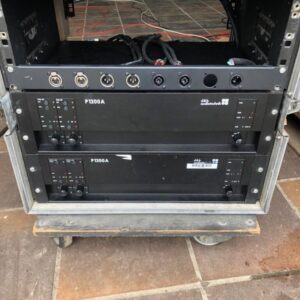
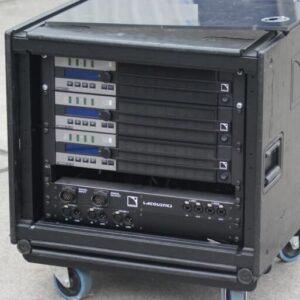
- External amplifier racks
- Complex signal chains
- Mismatch between amp and speaker
What This Adds
- Built-in DSP optimization
- Factory-calibrated performance
- Reduced setup time
Real Touring Benefit
- Faster load-in
- Lower crew requirements
- Reduced failure points
In high-pressure European touring environments, this is a major operational advantage.
SYSTEM DESIGN & PREDICTION (MAPP SOFTWARE)
Before deployment, engineers use:
- Meyer Sound MAPP
What Happens in Pre-Production
- Venue simulation
- SPL mapping
- Array angle optimization
Result On Site
- Minimal guesswork
- Faster tuning
- Consistent results across different venues
BUY MEYER SOUND MILO / M’ELODIE IN EUROPE
Who Should Invest
- Professional rental companies
- Touring production firms
- Large venues and arenas
Why Buying Makes Sense
- Proven rider demand
- Long operational lifespan
- High resale value
- Consistent ROI through rentals
This system is not experimental—it is battle-tested infrastructure.
RENT MEYER SOUND MILO / M’ELODIE IN EUROPE
Ideal For
- Touring productions
- Festivals
- One-off large-scale events
Rental Advantages
- No capital investment
- Fully configured system blocks
- On-site engineering support
MILO / M’ELODIE VS MODERN LINE ARRAYS
- l-acoustics → rider-dominant, newer systems
- d&b audiotechnik → precision engineering
- Meyer MILO → proven reliability and system stability
Key Insight
While newer systems exist, MILO remains relevant because:
- It is predictable
- It is stable
- It delivers consistent results
FINAL VERDICT – IS MILO / M’ELODIE STILL WORTH IT?
If your goal is:
- Touring reliability
- Scalable system design
- Consistent sound performance
Then the Meyer Sound MILO / M’elodie system is still a powerful, professional-grade solution in Europe.
What You Get
- High-output line array performance
- Seamless near-to-far coverage
- Integrated system design
- Proven real-world reliability
For Buyers
A long-term, revenue-generating asset
For Renters
A trusted, high-performance touring system that delivers under pressure
FAQ – Meyer Sound MILO / M’ELODIE
Is this system still used today?
Yes. It is widely used in touring and remains highly respected.
Can MILO and M’elodie be combined?
Yes. They are specifically designed to work together.
Are they self-powered?
Yes. Both systems include built-in amplification and DSP.
What events are they best for?
Festivals, arenas, touring productions, and large venues.
How scalable is the system?
Highly scalable—from medium-sized venues to large outdoor events.
Be the first to review “Meyer Sound MiLO/MeL”
Related products
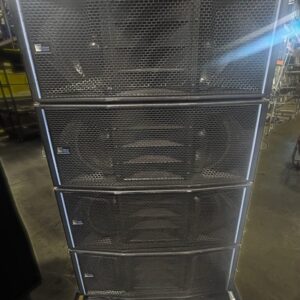
Meyer Sound
Complete System

Complete System

Complete System
Complete System
Complete System
Complete System
Complete System
Reviews
There are no reviews yet.